

OPDIVO (nivolumab) over 3-5 minutes1
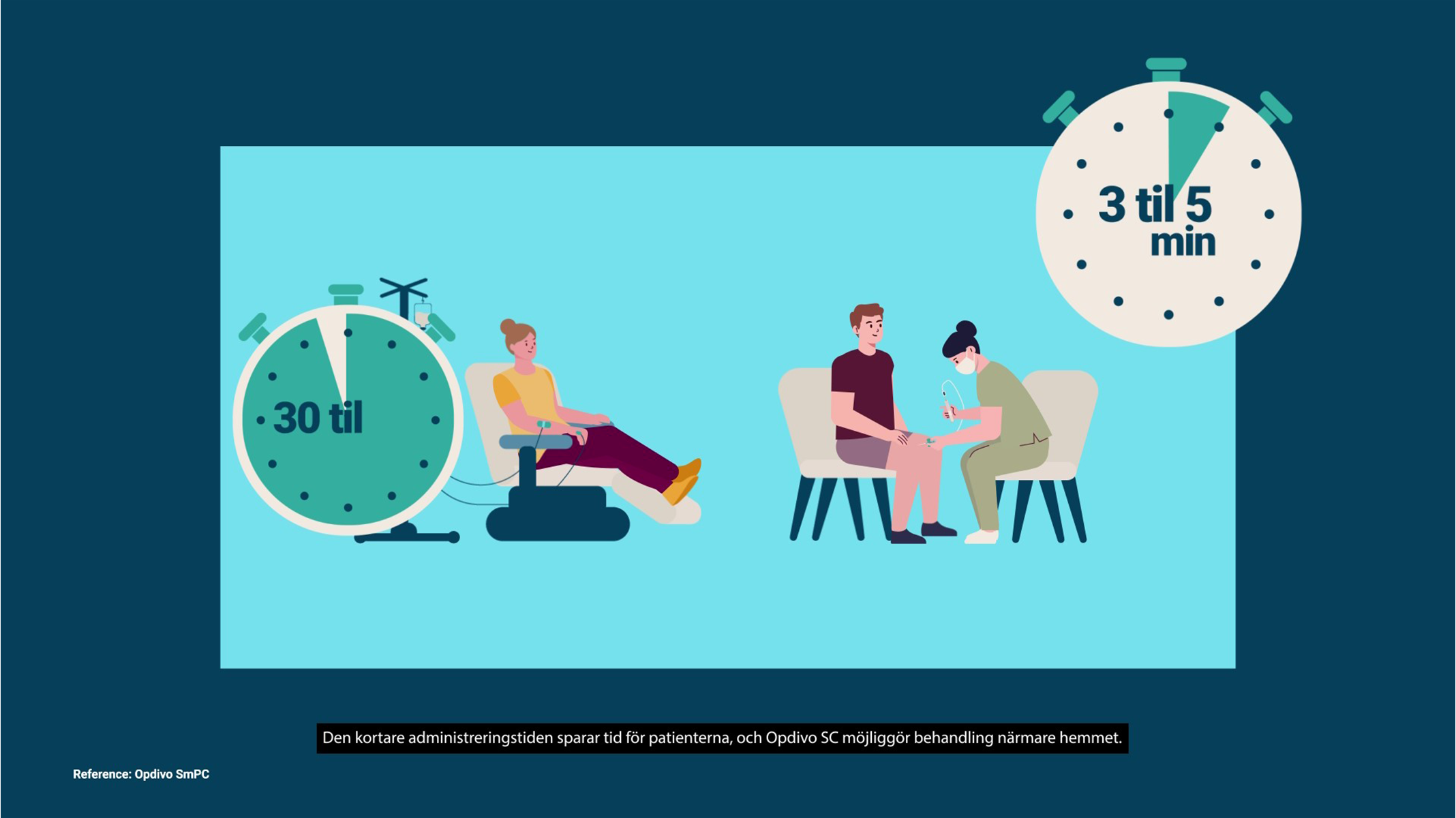
Treatment with OPDIVO (nivolumab) can be given as subcutaneous injection (SC) over 3–5 minutes as alternative to Intravenous Infusion (IV) over 30 minutes.
OPDIVO SC is approved to use alone or in combination with other cancer medicines across multiple solid tumours in adults:
- As monotherapy (adjuvant or metastatic)
- As monotherapy maintenance following completion of OPDIVO + YERVOY (ipilimumab) combination therapy
- In combination with chemotherapy or cabozantinib
See SmPC for specific indications approved for Opdivo SC


 |
MELANOMA | Adjuvant treatment of adults with Stage IIB or IIC melanoma, or melanoma with involvement of lymph nodes or metastatic disease who have undergone complete resection As monotherapy or in combination with ipilimumab for the treatment of advanced (unresectable or metastatic) melanoma in adults Relative to nivolumab monotherapy, an increase in progression-free survival (PFS) and overall survival (OS) for the combination of nivolumab with ipilimumab is established only in patients with low tumour PD-L1 expression |
 |
COLORECTAL CANCER | In combination with ipilimumab for the treatment of adult patients with mismatch repair deficient or microsatellite instability-high colorectal cancer in the following settings: - first-line treatment of unresectable or metastatic colorectal cancer - treatment of metastatic colorectal cancer after prior fluoropyrimidine-based combination chemotherapy |
 |
RENAL CELL CARCINOMA | In combination with ipilimumab for the first-line treatment of adult patients with intermediate/poor-risk advanced renal cell carcinoma In combination with cabozantinib is indicated for the first-line treatment of adult patients with advanced renal cell carcinoma As monotherapy for the treatment of advanced renal cell carcinoma after prior therapy in adults. |
 |
NON-SMALL CELL LUNG CANCER | In combination with platinum-based chemotherapy as neoadjuvant treatment, followed by OPDIVO as monotherapy as adjuvant treatment for the treatment of resectable non-small cell lung cancer at high risk of recurrence in adult patients whose tumours have PD-L1 expression ≥ 1% As monotherapy for the treatment of locally advanced or metastatic non-small cell lung cancer after prior chemotherapy in adults. |
 |
HEPATOCELLULAR CARCINOMA | In combination with ipilimumab for the first-line treatment of adult patients with unresectable or advanced hepatocellular carcinoma. |
 |
UROTHELIAL CARCINOMA | As monotherapy for the adjuvant treatment of adults with muscle invasive urothelial carcinoma (MIUC) with tumour cell PD-L1 expression ≥ 1%, who are at high risk of recurrence after undergoing radical resection of MIUC In combination with cisplatin and gemcitabine for the first-line treatment of adult patients with unresectable or metastatic urothelial carcinoma As monotherapy for the treatment of locally advanced unresectable or metastatic urothelial carcinoma in adults after failure of prior platinum-containing therapy. |
 |
OESOPHAGEAL SQUAMOUS CELL CARCINOMA | In combination with fluoropyrimidine- and platinum-based combination chemotherapy for the first-line treatment of adult patients with unresectable advanced, recurrent or metastatic oesophageal squamous cell carcinoma with tumour cell PD-L1 expression ≥ 1%. As monotherapy for the treatment of adult patients with unresectable advanced, recurrent or metastatic oesophageal squamous cell carcinoma after prior fluoropyrimidine- and platinum-based combination chemotherapy. |
|
ADJUVANT TREATMENT OF OESOPHAGEAL OR GASTRO-OESOPHAGEAL JUNCTION CANCER | As monotherapy for the adjuvant treatment of adult patients with oesophageal or gastro-oesophageal junction cancer who have residual pathologic disease following prior neoadjuvant chemoradiotherapy |
 |
GASTRO, GASTRO-OESOPHAGEAL JUNCTION OR OESOPHAGEAL ADENOCARCINOMA | In combination with fluoropyrimidine- and platinum-based combination chemotherapy for the first-line treatment of adult patients with HER2-negative advanced or metastatic gastric, gastro-oesophageal junction or oesophageal adenocarcinoma whose tumours express PD-L1 with a combined positive score (CPS) ≥ 5. |
 |
SQUAMOUS CELL CANCER OF THE HEAD AND NECK | As monotherapy for the treatment of recurrent or metastatic squamous cell cancer of the head and neck in adults progressing on or after platinum-based therapy |
See SmPC for indication specific instructions and dosing.

OPDIVO SC
600 mg q2w*
Allow 1 vial to reach room temperature, then withdraw 5 mL of OPDIVO solution for injection into the syringe
OPDIVO SC
1200 mg q4w*
Allow 2 vials to reach room temperature, then withdraw 10 mL of OPDIVO solution for injection into the syringe
*See SmPC for indication specific dosing and how to prepare the syringe

OPDIVO SC should be administered into the subcutaneous tissue of the abdomen (one of the four quadrants) or the thigh over 3-5 minutes.
Alternate injection sites for successive injections.

Hypodermic injection needle or with a subcutaneous administration set (“butterfly”) can be used for administration.

CheckMate-67T demonstrate consistent efficacy, non-inferior exposure, and comparable safety to IV nivolumab2
CheckMate 67T is a randomized, open label Phase 3 trial designed to evaluate the pharmacokinetics, efficacy, and safety of OPDIVO SC (nivolumab subcutaneous injection) compared with nivolumab IV (intravenous infusion) in patients with advanced or metastatic clear cell renal cell carcinoma.
A total of 495 patients who had received ≤2 prior systemic therapies were randomized to receive either OPDIVO SC or nivolumab IV. The minimum follow up was 8 months.
Co primary PK endpoints (noninferiority): Cavg,d28 (time averaged concentration over 28 days) and Cmin,ss (minimum concentration at steady state)
Secondary endpoint: Overall Response Rate (ORR) assessed by blinded independent central review (BICR), Progression free survival (PFS) and Safety outcomes
Key Findings from CheckMate 67T
- OPDIVO SC met the predefined non inferiority criteria for both PK endpoints, demonstrating comparable systemic exposure to IV nivolumab.
- ORR: 24% with OPDIVO SC vs 18% with IV nivolumab. This demonstrated similar efficacy, with a numerically higher response rate in the SC arm.
- The safety profile of OPDIVO SC was comparable to IV nivolumab, with the most common adverse events including fatigue, musculoskeletal pain, pruritus, rash, and cough.
Link to full publication: Subcutaneous versus intravenous nivolumab for renal cell carcinoma - PubMed
1506-NOR-2600003/ Developed Feb 10 2026
Reference 1. OPDIVO SmPC. 2. Albiges et al. Annals of Oncology Vol 36, issue 1, Jan 2025 p99-107
Opdivo SC introduction video in Swedish
2.40 min. Produktresumé för våra godkända läkemedel på FASS: OPDIVO® (nivolumab)
1506-NOR-2600005/ Developed March 03 2026
OPDIVO® (nivolumab) 10 mg/ml koncentrat till infusionsvätska, lösning (IV). 300 mg resp. 600 mg injektionsvätska, lösning (SC). Antineoplastiska medel, monoklonala antikroppar, PD-1 hämmare, L01FF01.
INDIKATIONER (*=Endast godkänd för IV):
Melanom OPDIVO som monoterapi är indicerat för adjuvant behandling av vuxna (och ungdomar 12 år och äldre)* efter total resektion av melanom i stadium IIB eller IIC, melanom som involverat lymfkörtlar eller som har metastaserat. OPDIVO som monoterapi eller i kombination med YERVOY® är indicerat för behandling av vuxna (och ungdomar 12 år och äldre)* med avancerat (icke-resektabelt eller metastaserande) melanom. Jämfört med OPDIVO monoterapi har en ökning av progressionsfri överlevnad och totalöverlevnad med kombinationen OPDIVO och YERVOY endast visats hos patienter med lågt tumöruttryck av PD-L1.
Icke-småcellig lungcancer (NSCLC) OPDIVO i kombination med platinabaserad kemoterapi är indicerat för neoadjuvant behandling av resektabel NSCLC med hög risk för återfall hos vuxna vars tumörer har PD-L1-uttryck ≥ 1 %. OPDIVO i kombination med platinabaserad kemoterapi för neoadjuvant behandling, följt av OPDIVO som monoterapi för adjuvant behandling, är indicerat för behandling av resektabel icke småcellig lungcancer med hög risk för återfall hos vuxna vars tumörer har PD L1 uttryck ≥ 1 %. OPDIVO i kombination med YERVOY och två behandlingscykler platinabaserad kemoterapi är indicerat som första linjens behandling av vuxna med metastaserande NSCLC vars tumörer varken har sensibiliserande EGFR-mutation eller ALK-translokation*. OPDIVO som monoterapi är indicerat för behandling av vuxna med lokalt avancerad eller metastaserande NSCLC efter tidigare kemoterapi.
Malignt pleuramesoteliom (MPM) OPDIVO i kombination med YERVOY är indicerat som första linjens behandling av vuxna med icke-resektabelt malignt pleuramesoteliom*.
Njurcellscancer (RCC) OPDIVO i kombination med YERVOY är indicerat som första linjens behandling av vuxna med avancerad njurcellscancer med intermediär/dålig prognos. OPDIVO i kombination med kabozantinib är indicerat som första linjens behandling av vuxna med avancerad njurcellscancer. OPDIVO som monoterapi är indicerat för behandling av vuxna med avancerad njurcellscancer efter tidigare behandling.
Klassiskt Hodgkins lymfom (cHL) OPDIVO i kombination med doxorubicin, vinblastin och dakarbazin (AVD) är indicerat som första linjens behandling av vuxna och ungdomar 12 år och äldre med cHL i stadium III eller IV*. OPDIVO i kombination med brentuximab vedotin är indicerat för behandling av barn från 5 års ålder samt hos ungdomar och vuxna upp till 30 års ålder med recidiverande eller refraktärt cHL efter en tidigare behandling*. OPDIVO som monoterapi är indicerat för behandling av vuxna med recidiverande eller refraktärt cHL efter autolog stamcellstransplantation och behandling med brentuximab vedotin*.
Skivepitelial huvud- och halscancer (SCCHN) OPDIVO som monoterapi är indicerat för behandling av återkommande eller metastaserande SCCHN hos vuxna som progredierat under eller efter platinabaserad behandling.
Urotelcellscancer (UC) OPDIVO som monoterapi är indicerat för adjuvant behandling av vuxna med muskelinvasiv UC (MIUC) med PD-L1 tumörcellsuttryck ≥ 1 % och hög risk för återfall efter radikal resektion. OPDIVO i kombination med cisplatin och gemcitabin är indicerat som första linjens behandling av vuxna med icke-resektabel eller metastaserande UC. OPDIVO som monoterapi är indicerat för behandling av lokalt avancerad icke-resektabel eller metastaserande UC hos vuxna vid otillräcklig effekt av tidigare platinabaserad behandling.
Kolorektalcancer (CRC) OPDIVO i kombination med YERVOY är indicerat för behandling av vuxna med kolorektalcancer som uppvisar defekt mismatch repair eller hög mikrosatellitinstabilitet: som första linjens behandling av icke-resektabel eller metastaserande CRC, eller efter tidigare fluoropyrimidinbaserad kemoterapi i kombination.
Esofaguscancer av skivepiteltyp (OSCC) OPDIVO i kombination med YERVOY är indicerat som första linjens behandling av vuxna med icke-resektabel avancerad, återkommande eller metastaserande OSCC med PD-L1 tumörcellsuttryck ≥ 1 %*. OPDIVO i kombination med fluoropyrimidin- och platinabaserad kemoterapi är indicerat som första linjens behandling av vuxna med icke-resektabel avancerad, återkommande eller metastaserande OSCC med PD-L1 tumörcellsuttryck ≥ 1 %. OPDIVO som monoterapi är indicerat för behandling av vuxna med icke-resektabel avancerad, återkommande eller metastaserande OSCC efter tidigare fluoropyrimidin- och platinabaserad kemoterapi i kombination.
Adjuvant behandling av esofaguscancer eller cancer i gastroesofageala övergången (OC eller GEJC) OPDIVO som monoterapi är indicerat för adjuvant behandling av vuxna med esofaguscancer eller cancer i gastroesofageala övergången med kvarstående mikroskopisk sjukdom efter tidigare neoadjuvant kemoradioterapi.
Adenocarcinom i ventrikeln, gastroesofageala övergången (GEJ) eller esofagus OPDIVO i kombination med fluoropyrimidin- och platinabaserad kemoterapi är indicerat som första linjens behandling av vuxna med HER2-negativt avancerat eller metastaserande adenocarcinom i ventrikeln, gastroesofageala övergången eller esofagus vars tumörer uttrycker PD-L1 ≥ 5 (CPS).
Hepatocellulärt karcinom (HCC) OPDIVO i kombination med YERVOY är indicerat som första linjens behandling av vuxna med icke-resektabelt eller avancerat HCC.
VARNINGAR OCH FÖRSIKTIGHET: Behandling ska initieras och övervakas av specialistläkare med erfarenhet av cancerbehandling.
Immunrelaterade biverkningar: OPDIVO är associerat med immunrelaterade biverkningar som kan påverka flera system i kroppen samtidigt. Fall med dödlig utgång har förekommit. Tidig diagnos av dessa och lämplig behandling är nödvändig för att minimera livshotande komplikationer. Baserat på biverkningens allvarlighetsgrad, ska uppehåll med Opdivo eller kombinationsbehandling med Opdivo göras och kortikosteroider administreras. Patienter bör övervakas kontinuerligt (i minst 5 månader efter sista dosen) då en biverkning kan ske när som helst under eller efter avslutad behandling. Immunrelaterade biverkningar inträffade med högre frekvens när Opdivo administrerades i kombination med Yervoy, och med liknande frekvens när Opdivo administrerades i kombination med kabozantinib eller brentuximab vedotin, jämfört med Opdivo som monoterapi.
Andra viktiga varningar och försiktighetsåtgärder: Kan öka avstötningsrisken hos organtransplanterade patienter. Allvarliga infusionsreaktioner har rapporterats.
Melanom: Innan behandling av patienter med snabbt progredierande sjukdom, ska läkaren överväga den fördröjda effekten av OPDIVO.
OSCC: Innan behandling av patienter med snabbt progredierande sjukdom, ska läkaren överväga den fördröjda effekten av OPDIVO och OPDIVO i kombination med YERVOY.
NSCLC och SCCHN efter tidigare kemoterapi: Innan behandling av patienter med sämre prognostiska faktorer och/eller aggressiv sjukdom, ska läkaren överväga den fördröjda effekten av OPDIVO.
RCC: När OPDIVO ges med kabozantinib har högre frekvens av ALAT-och ASAT-stegring, Grad 3 och 4, rapporterats jämfört med OPDIVO monoterapi. Leverenzymvärden ska monitoreras innan behandling påbörjas och regelbundet under pågående behandling. Följ riktlinjerna i respektive produkts produktresumé.
cHL: Det finns en ökad risk för akut graft versus host disease (GVHD) vid användning av OPDIVO före och efter allogen hematopoetisk stamcellstransplantation. Nyttan med behandlingen respektive stamcellstransplantationen måste övervägas från fall till fall. I kombination med AVD har högre frekvens av neutropeni grad 3–4 rapporterats; fullständig blodstatus ska utföras före varje cykel och G-CSF-profylax ska övervägas hos patienter med ökad risk för febril neutropeni.
HCC: Data för patienter med hepatocellulärt karcinom och Child Pugh B är begränsade. Sämre prognostiska faktorer kan vara associerat med en högre risk för död de första 6 månaderna vid behandling med OPDIVO i kombination med YERVOY. Överväg detta innan behandling påbörjas.
INTERAKTIONER: Användning av systemiska kortikosteroider och annan immunsuppressiv behandling bör undvikas före start av OPDIVO på grund av dess möjliga påverkan på den farmakodynamiska aktiviteten.
FÖRPACKNINGAR: 10 mg/ml IV: 1 injektionsflaska om 4 ml, 10 ml, 12 ml eller 24 ml. 600 mg SC: 1 injektionsflaska om 5 ml.
ÖVRIG INFORMATION: Rx, EF. För fullständig information, se www.fass.se. Baserad på produktresumé: 2026-07-23. Bristol Myers Squibb, Tel. 08-704 71 00, www.bms.com/se